
Last checked: November 11, 2026 (JST).
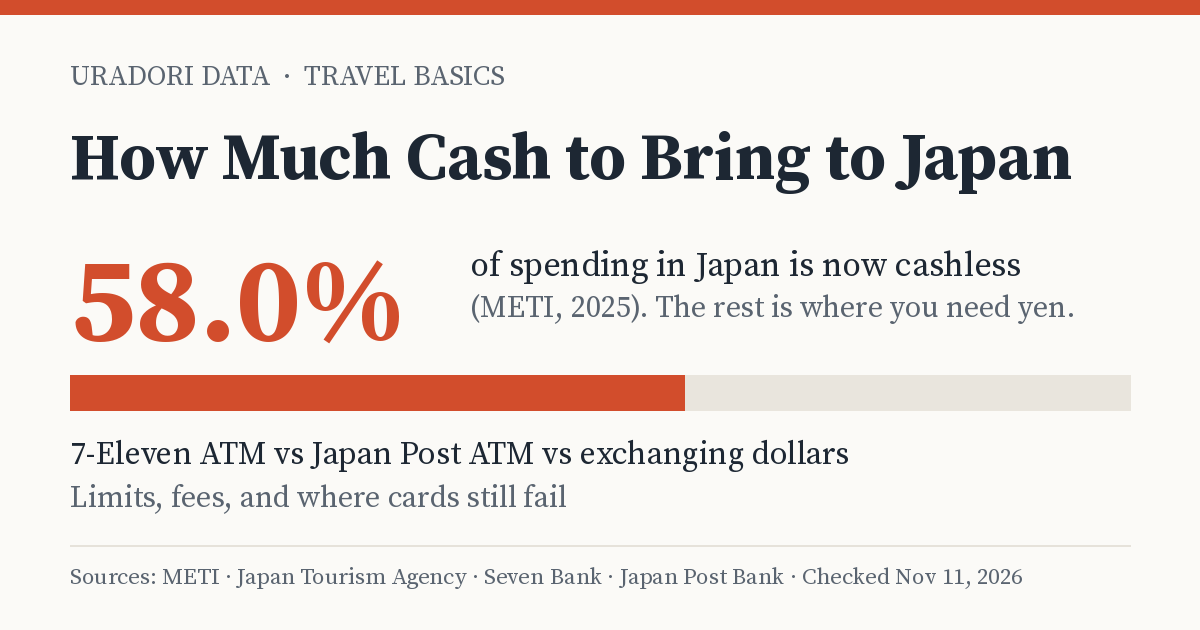
Quick answer: You need less cash in Japan than older guides suggest, but not zero. Cards and phone payments covered 58.0% of household spending in 2025, according to Japan’s Ministry of Economy, Trade and Industry (METI). The cash gaps are predictable: small restaurants, shrine and temple counters, local buses, and topping up a plastic Welcome Suica, which only takes yen bills. Our rule of thumb is to land with nothing and withdraw ¥20,000 to ¥30,000 per adult (about $126 to $190) at an airport 7-Eleven or Japan Post ATM, then top up as you go. Plan on more for rural trips.
How cashless is Japan now?
METI’s latest figure, published March 31, 2026, puts Japan’s cashless payment ratio for 2025 at 58.0%, or ¥162.7 trillion. Credit cards made up 82.7% of that, code payments such as PayPay 10.2%, e-money like Suica 3.7%, and debit cards 3.4%.
Two caveats before you leave your wallet at home. First, METI changed its headline measure this year. The new “domestic indicator” leaves imputed rent out of total spending. Under the old international method, 2025 comes out at 46.3%. Second, the share that isn’t cashless isn’t all cash. It also covers bank transfers and direct debits, things a tourist never touches. So read 58% as “most spending,” not “42% of shops are cash only.”
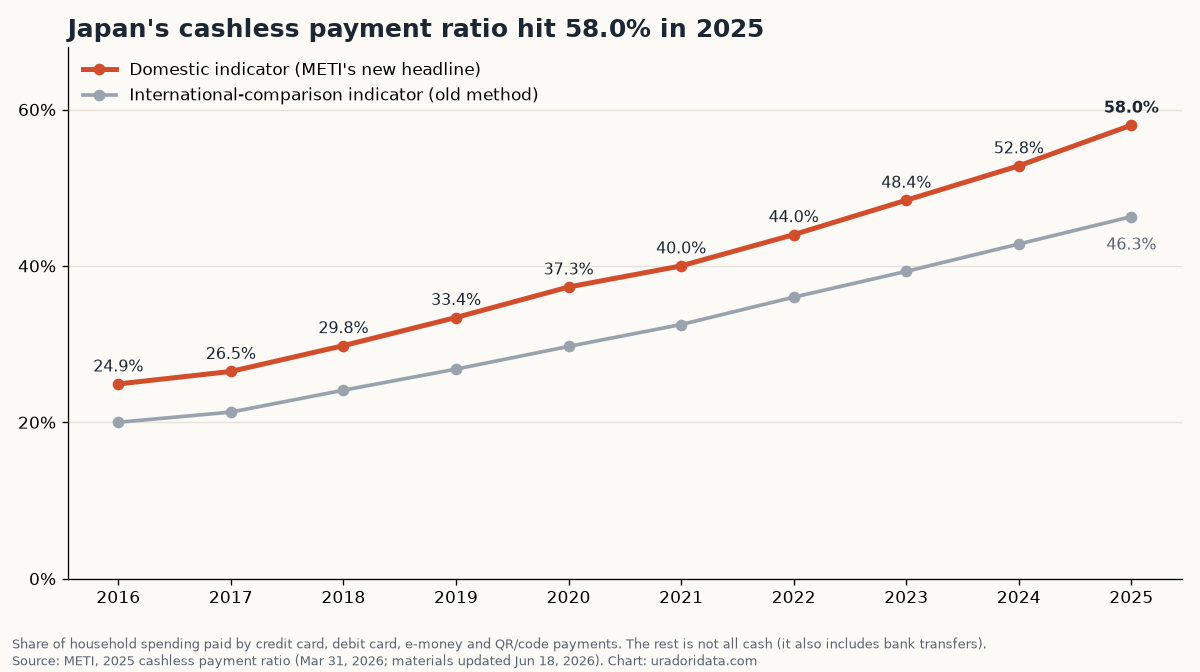
The ratio has more than doubled since 2016 (24.9%). Visitors see the same picture: in the tourism survey below, nearly 9 in 10 departing travelers didn’t report trouble paying by card.
Where cards still fail for visitors
The Japan Tourism Agency (JTA) asks departing travelers at five airports what went wrong on their trip. In the latest round (4,110 people, November 2025 to January 2026), 10.7% said they had trouble using a credit or debit card. That’s up from 7.0% in fiscal 2023 and 7.8% in fiscal 2024, and it now ranks sixth among all complaints.
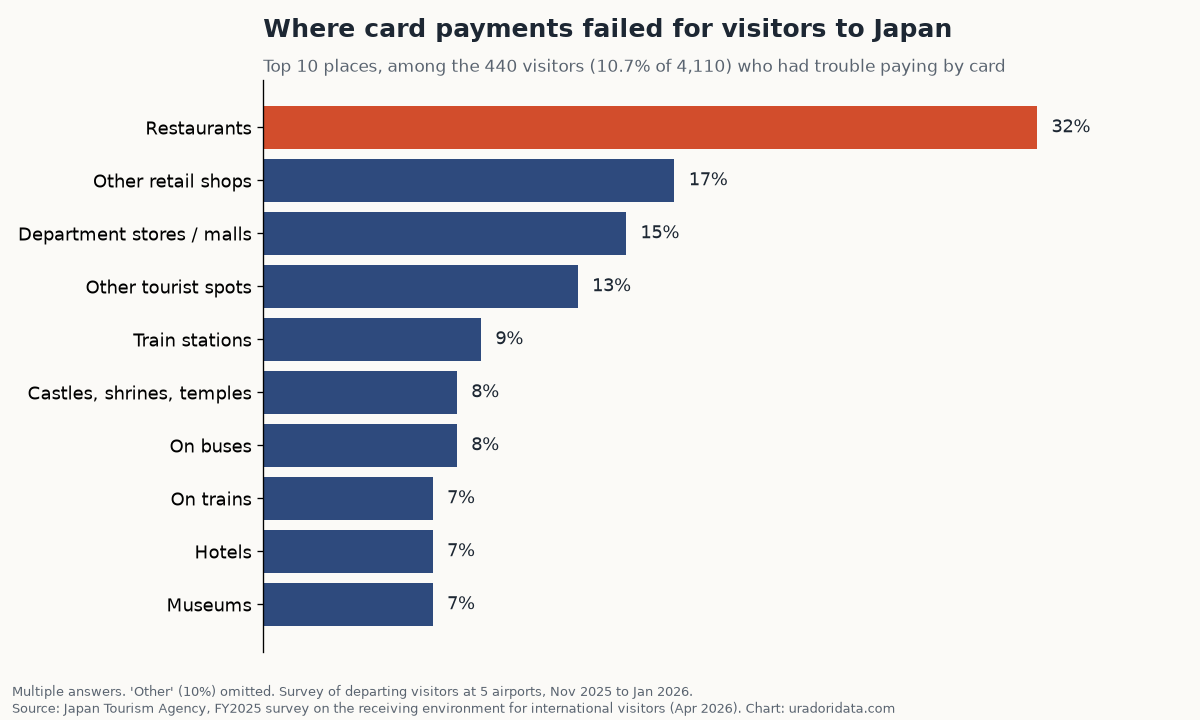
Restaurants topped the list at 32%. Castles, shrines and temples (8%) and buses (8%) also show up. When asked what went wrong, 46% said the card simply didn’t work, 23% said the place didn’t accept cards, and another 23% couldn’t tell whether cards were accepted. That last one is fixable: ask before you order, or look for card logos at the register.
When you’ll want yen in your pocket
- Small restaurants. They’re the most common place cards fail in the JTA data (32% of card problems). Some small shops order through a ticket machine at the door, and not every machine takes cards.
- Topping up a plastic Welcome Suica. JR East says only yen can be used and a credit card can’t top it up. You can do it at marked station machines or at Seven Bank ATMs, up to a ¥20,000 balance. Welcome Suica Mobile on iPhone tops up with Apple Pay instead (our Suica guide compares the options).
- Shrines and temples. Offerings go in a box as coins or bills, and castles, shrines and temples account for 8% of the card problems in the JTA survey. Have small bills for entry fees and charms at smaller sites.
- Local buses and rural areas. In the JTA survey, buses were where visitors to rural areas most often had transport trouble, and buses also appear on the card-trouble list.
- Small, quick purchases. Keep a few ¥100 coins and ¥1,000 bills for things like coin lockers, market stalls and festival food stands, where a card reader isn’t guaranteed.
Three ways to get yen, compared
For most US visitors the choice comes down to two ATM networks that take foreign cards, or exchanging dollar bills. Here’s what each operator actually publishes.
1. Seven Bank ATMs (7-Eleven)
- Where: over 28,000 ATMs, in 7-Eleven stores and at airports including Narita, Haneda, Kansai, New Chitose, Chubu, Fukuoka and Naha.
- Hours: Visa and Mastercard 24 hours; Amex, JCB, Discover, UnionPay and Diners have short overnight breaks.
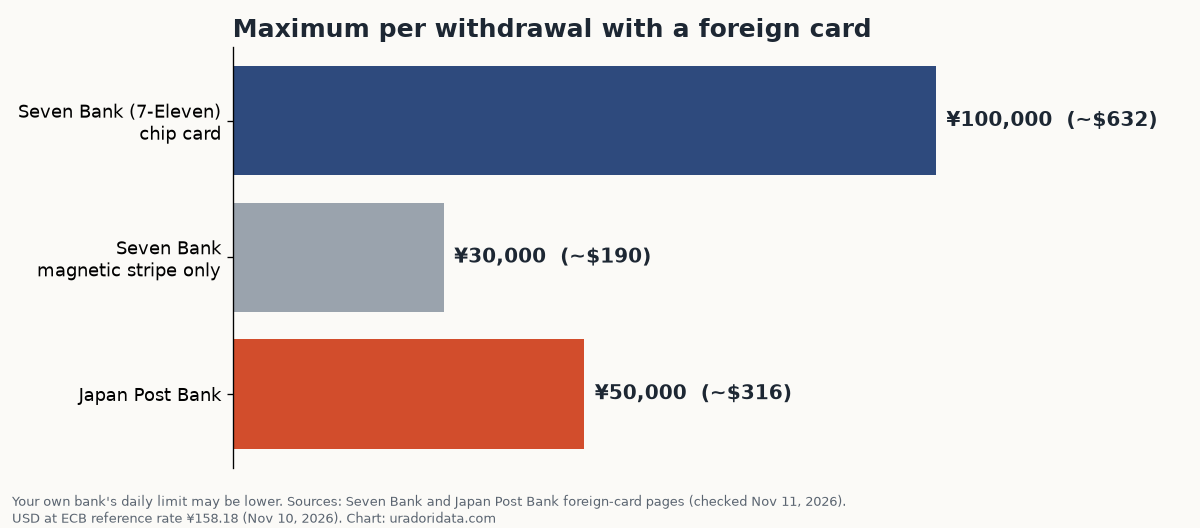
- Limit: ¥100,000 per withdrawal, or ¥30,000 for magnetic-stripe transactions.
- Fee: Seven Bank doesn’t publish one yen amount for foreign cards. It says only that fees vary by card brand. Your bank may add its own fee.
2. Japan Post Bank ATMs
- Where: every Japan Post Bank ATM in the country, including post offices and compact ATMs in FamilyMart stores. Useful in small towns.
- Hours: post office ATMs 7:00 a.m. to 11:00 p.m. Monday to Saturday, 7:00 a.m. to 9:00 p.m. on Sundays and holidays; FamilyMart compact ATMs 12:05 a.m. to 11:55 p.m. Hours vary by machine.
- Limit: ¥50,000 per withdrawal.
- Fee: Japan Post says an ATM fee of ¥220 per use “may apply” with certain cards issued abroad. Your bank’s fee comes on top.
3. Exchanging US dollar bills
Changing cash has no per-transaction fee, but the cost is built into the rate. As a benchmark, MUFG Bank’s published cash buying rate on November 10, 2026 was ¥155.14 per dollar, ¥3.00 below its mid-rate of ¥158.14. At that rate, ¥30,000 costs about $193, versus about $190 at the European Central Bank’s reference rate of ¥158.18 that day. Airport exchange counters and US banks set their own rates, so compare the rate on the board before you hand over bills.
| Option | What the operator publishes |
|---|---|
| Seven Bank ATM | ¥100,000 per withdrawal (¥30,000 magnetic stripe). Fee varies by card brand. Visa/Mastercard 24 hours. |
| Japan Post ATM | ¥50,000 per withdrawal. ¥220 per use may apply with certain foreign cards. Post office ATMs 7 a.m. to 9 or 11 p.m. |
| Exchange dollars | No ATM fee; cost is in the rate. MUFG cash rate ¥155.14 vs mid ¥158.14 (Nov 10, 2026). |
Our pick: use an ATM with a debit card that doesn’t charge foreign transaction or out-of-network ATM fees, and take out fewer, larger amounts. If your card charges a 3% foreign transaction fee, that’s about ¥900 on ¥30,000, several times a ¥220 ATM fee, so your bank’s terms can matter more than which ATM you pick. Bring a small stack of dollars only as a backup in case your card is blocked.
Want to run your own numbers? Our free Japan Cash & ATM Fee Calculator adds your card’s foreign transaction and ATM fees to a 7-Eleven or Japan Post withdrawal and compares the total with exchanging dollar bills.
So how much cash should you carry?
There’s no official number for this, so here’s how we’d size it. These are our suggestions, not survey data.
| Trip style | Cash on hand (per adult) |
|---|---|
| Tokyo/Osaka city trip, card-friendly hotels and chains | ¥10,000–¥20,000 (about $63–$126) |
| Kyoto temples, small restaurants, plastic Welcome Suica | ¥20,000–¥30,000 (about $126–$190) |
| Rural towns, local buses, ryokan, festivals | ¥30,000–¥50,000 (about $190–$316), and know where the post office is |
Refill when you drop to about ¥5,000, not when you hit zero. Small towns may have no 7-Eleven nearby, and post office ATMs close at night.
ATM tips that save money
- Choose yen when the screen asks about currency. Seven Bank offers Dynamic Currency Conversion (DCC) on Visa and Mastercard, and Japan Post offers a similar option on some cards. Seven Bank explains that picking your home currency fixes the dollar amount at the ATM, while picking yen leaves the conversion to your card company at billing. Unless the dollar rate shown is close to the mid-market rate, pick yen.
- Withdraw fewer, larger amounts. Seven Bank says fees are charged per transaction, so splitting ¥60,000 into three withdrawals can triple the fee.
- Know your daily limit. Your bank’s daily cap can be lower than the ATM limit. If a withdrawal is refused, Seven Bank suggests lowering the amount and trying again.
- Don’t guess your PIN. After a PIN error, Seven Bank tells you to contact your card issuer.
- Tell your bank you’re traveling and make sure your card has a chip, since magnetic-stripe withdrawals are capped at ¥30,000 at Seven Bank.
FAQ
Is Japan still a cash society? Less than it was. METI puts the cashless share of household spending at 58.0% in 2025, up from 24.9% in 2016. Cash is still useful at small restaurants, shrines and temples, and on local buses.
Should I get yen before I leave the US? You don’t have to. Seven Bank lists ATMs at Narita, Haneda, Kansai and other major airports. If you’d feel better with some yen on arrival, compare your bank’s rate with the mid-market rate first.
Which ATM is cheapest? On the Japanese side, Japan Post publishes ¥220 per use for certain foreign cards. Seven Bank doesn’t publish a single amount and says it varies by card brand. Your own bank’s fees often decide which ends up cheapest. You can plug your card’s fees into our calculator to compare.
Can I pay the departure tax or tax-free refund in cash? The departure tax is built into your ticket, so there’s nothing to pay at the airport (details here). For tax-free shopping, see how the new airport refund works.
Sources
- METI, 2025 cashless payment ratio (March 31, 2026; materials updated June 18, 2026; Japanese): meti.go.jp
- Japan Tourism Agency, FY2025 survey on the receiving environment for international visitors, press release (April 28, 2026; Japanese): PDF and full results: PDF
- Seven Bank, ATMs for foreign-issued cards: overview, cards, hours and limits, how to use and DCC
- Japan Post Bank, International ATM Service: jp-bank.japanpost.jp
- JR East, Welcome Suica purchase and top-up: jreast.co.jp
- MUFG Bank, foreign exchange quotations as of November 10, 2026 (Japanese): bk.mufg.jp
- European Central Bank reference rate via Frankfurter, USD/JPY 158.18 on November 10, 2026.