
Last checked: November 10, 2026 (JST).
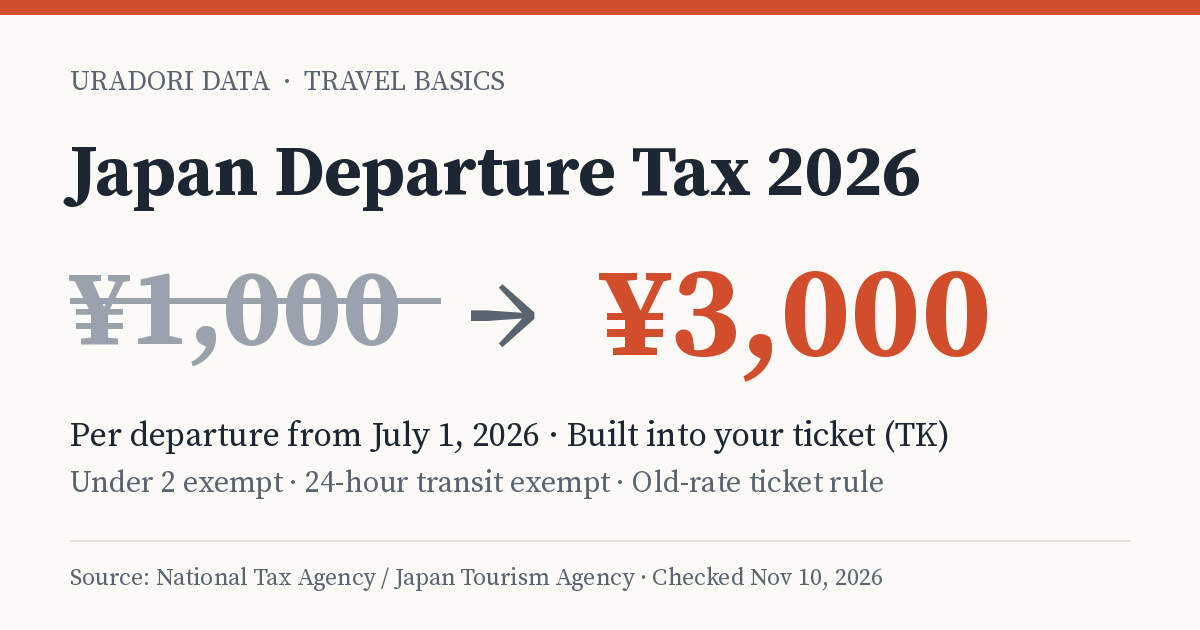
Quick answer: Japan’s departure tax, officially the International Tourist Tax, is now ¥3,000 per departure (about $19). It tripled from ¥1,000 for departures on or after July 1, 2026. You don’t pay it at the airport: airlines and cruise lines add it to your ticket, where it usually shows up as tax code TK. Children under 2 and qualifying transit passengers who leave within 24 hours are exempt. If your ticket was issued before July 1, 2026 with a fixed departure date, the old ¥1,000 rate can still apply.
What changed in 2026
Japan introduced the International Tourist Tax on January 7, 2019, at ¥1,000 every time someone leaves the country by plane or ship. The fiscal 2026 tax reform raised it to ¥3,000, and the higher rate applies to departures on or after July 1, 2026.
The National Tax Agency says the extra money is meant to pay for tourism measures, including dealing with overtourism, spreading visitors beyond the big cities, and outbound travel programs. The Japan Tourism Agency’s leaflet lists examples such as walk-through immigration gates, automated bag drops, smart trash bins, and trail maintenance.
| Before | Now | |
|---|---|---|
| Rate per departure | ¥1,000 | ¥3,000 |
| In US dollars* | about $6 | about $19 |
| Applies to | Departures Jan 7, 2019 to Jun 30, 2026 | Departures from Jul 1, 2026 (with a transition rule below) |
| How it’s paid | Added to the ticket by the airline or cruise line | |
Who pays it
Everyone who leaves Japan by air or sea pays, whatever their nationality or reason for travel. That includes tourists, business travelers, students, and Japanese citizens. It isn’t a visitor-only charge.
The tax is charged once per departure, not per flight segment. A round trip from the US to Japan means one departure from Japan, so one ¥3,000 charge. If you fly out to Seoul and come back into Japan before flying home, that’s two departures and two charges.
Who doesn’t pay (exemptions)
According to the NTA, these travelers are not taxed:
- Children under 2 on the day of departure.
- Transit passengers who leave within 24 hours of arriving, but only when both flights are on one ticket and the itinerary on that ticket shows the onward flight leaving within 24 hours. Two separate bookings don’t qualify.
- Aircraft and ship crew, people on government planes or ships, deportees, and travelers diverted to or back into Japan by bad weather or other unavoidable reasons.
- Certain diplomats, state guests, and US forces or UN forces personnel traveling on official duty, through a separate exemption procedure.
There’s no exemption for seniors, students, or short stays, and no refund because you only spent one night.
Bought your ticket before July 1? The old-rate rule
A transition rule keeps the old ¥1,000 rate for some tickets. The test is when the contract with the airline was made, not when you booked a package with a travel agency. You get the old rate only if all of these are true:
- Your contract with the airline or cruise line was made before July 1, 2026 (in practice, the ticket was issued by June 30).
- The departure date was already fixed at that point.
- You didn’t change the departure date on or after July 1.
Open-date tickets with the date set later, and any date change made on or after July 1, move you to the ¥3,000 rate. The rule also doesn’t apply when the carrier’s terms say it collects the tax separately from the fare. By now, most people booking a winter or spring trip are simply paying ¥3,000.
How it’s collected and where to find it on your ticket
You won’t see a desk or machine for this tax at Narita, Haneda, or Kansai. The airline collects it when you buy the ticket and passes it to the government. ANA lists the International Tourist Tax under tax code TK, and many e-ticket receipts and fare breakdowns use the same code. Booking sites often lump everything into one “taxes and fees” number, so check the detailed receipt if you want to see it.
Some airlines charge it in your home currency. The amount Japan receives is still ¥3,000.
The only time a traveler pays it directly is when no airline or cruise line is involved, such as on a private jet. Then you pay customs at the departure port before boarding.
What you actually pay to leave Japan
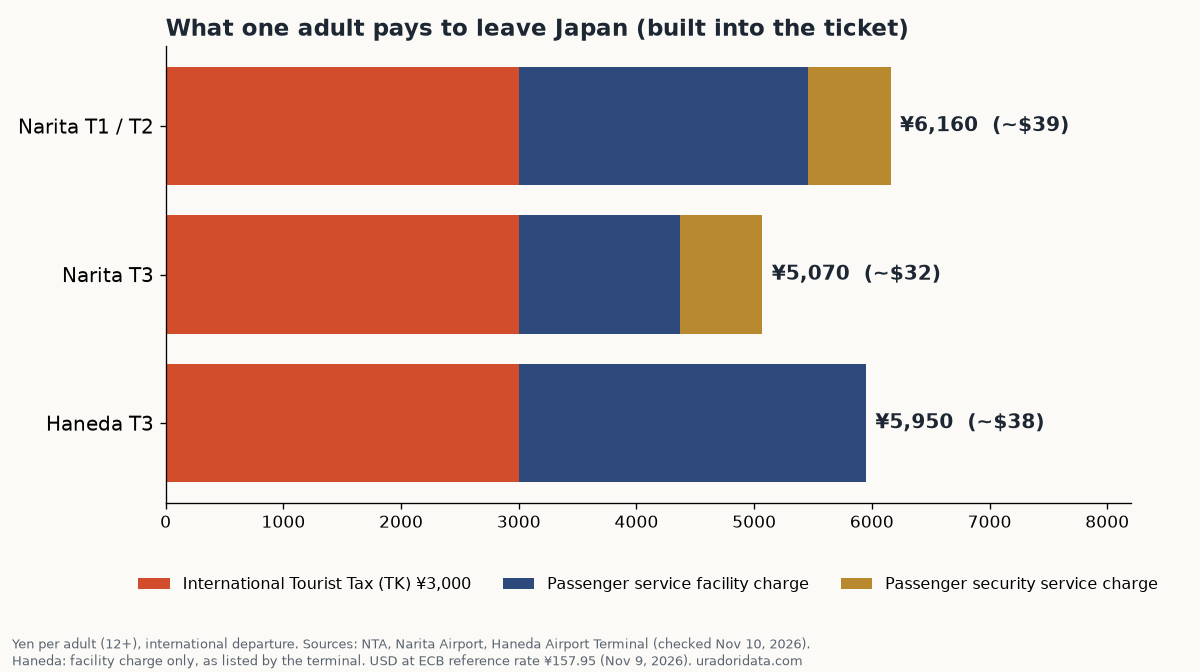
The tax isn’t the only departure charge in your fare. Airports add their own facility and security charges, and they vary by terminal. Here’s what one adult (12 or older) pays on an international departure, using the airports’ published rates.
| Departing from | Total per adult |
|---|---|
| Narita, Terminal 1 or 2 | ¥6,160 (~$39) tax ¥3,000 + facility ¥2,460 + security ¥700 |
| Narita, Terminal 3 | ¥5,070 (~$32) tax ¥3,000 + facility ¥1,370 + security ¥700 |
| Haneda, Terminal 3 | ¥5,950 (~$38) tax ¥3,000 + facility ¥2,950 (no security charge listed by the terminal) |
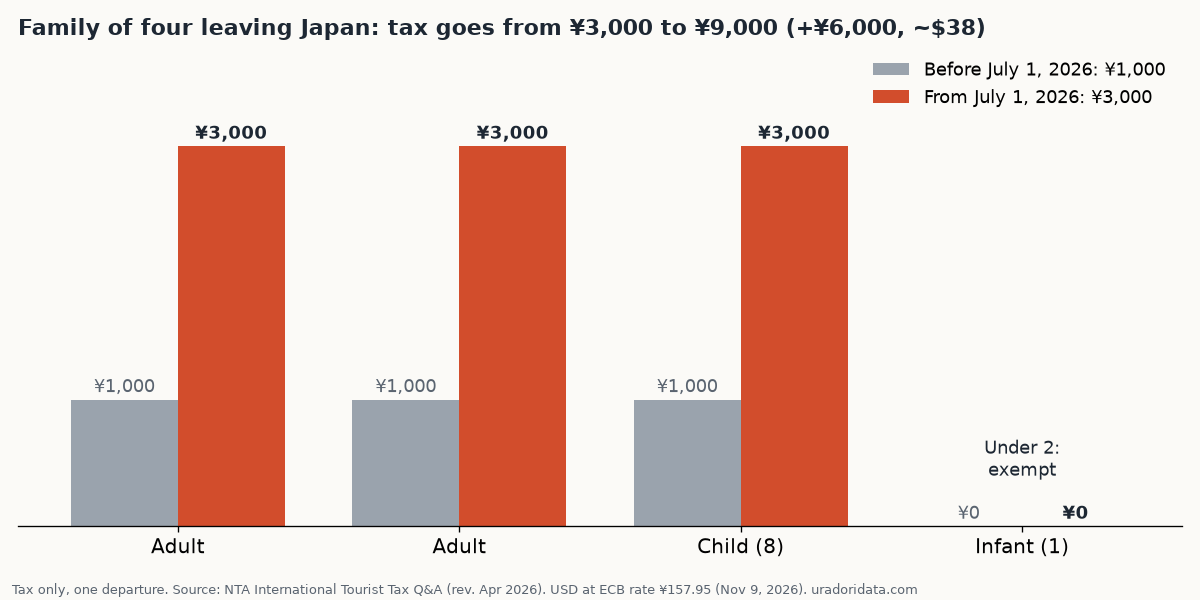
For a family the tax is the part that grew. Two adults, an 8-year-old, and a 1-year-old paid ¥3,000 in tourist tax before July; the same family now pays ¥9,000. The baby is still exempt.
Common mistakes
- Budgeting cash for it at the airport. There’s nothing to pay there if you’re on a commercial flight.
- Assuming a layover is free. The 24-hour exemption needs one ticket that shows the connection. A self-made connection on two tickets, or a stay longer than 24 hours, gets taxed.
- Changing an old ticket’s date. If you hold a ticket issued before July 1 and change the departure date now, the old ¥1,000 rate no longer applies.
- Mixing it up with hotel taxes. Accommodation taxes in places such as Tokyo, Osaka, and Kyoto are set by local governments and charged by hotels. They’re separate from this national tax.
FAQ
How much is Japan’s departure tax in 2026? ¥3,000 per departure for departures on or after July 1, 2026. Before that it was ¥1,000.
Do I pay it at the airport? No. It’s included in the price of your plane or cruise ticket.
Do kids pay? Children 2 and older pay the full ¥3,000. Under 2 is exempt.
I have a Tokyo layover on the way to Asia. Do I pay? Not if you leave within 24 hours of arriving and both flights are on a single ticket that shows the connection. A longer stay, or two separate tickets, means you pay.
Is it refundable if I cancel my flight? If you never leave Japan on that ticket, there’s no departure to tax. Refunds of taxes on unused tickets go through your airline, so check its refund policy.
Sources
- National Tax Agency, International Tourist Tax basic knowledge (English): nta.go.jp
- National Tax Agency, Tax Answer No. 7195, as of July 1, 2026 (Japanese): nta.go.jp
- National Tax Agency, International Tourist Tax Q&A, revised April 2026 (Japanese): PDF
- Japan Tourism Agency, leaflet on the July 2026 rate increase (Japanese): PDF
- International Tourist Tax Act, e-Gov law database: laws.e-gov.go.jp
- ANA, tax codes and consumption tax on international fares (TK = International tourist tax): ana-support
- Narita International Airport, PSFC and PSSC: narita-airport.jp
- Haneda Airport Terminal, international departure procedures and facility charge (Japanese): tokyo-haneda.com
- European Central Bank reference rate via Frankfurter, USD/JPY 157.95 on November 9, 2026.