
Last checked: November 12, 2026 (JST). Prices are for one adult in yen; dollar figures use the ECB reference rate of ¥159.23 per US$1 (November 11, 2026).
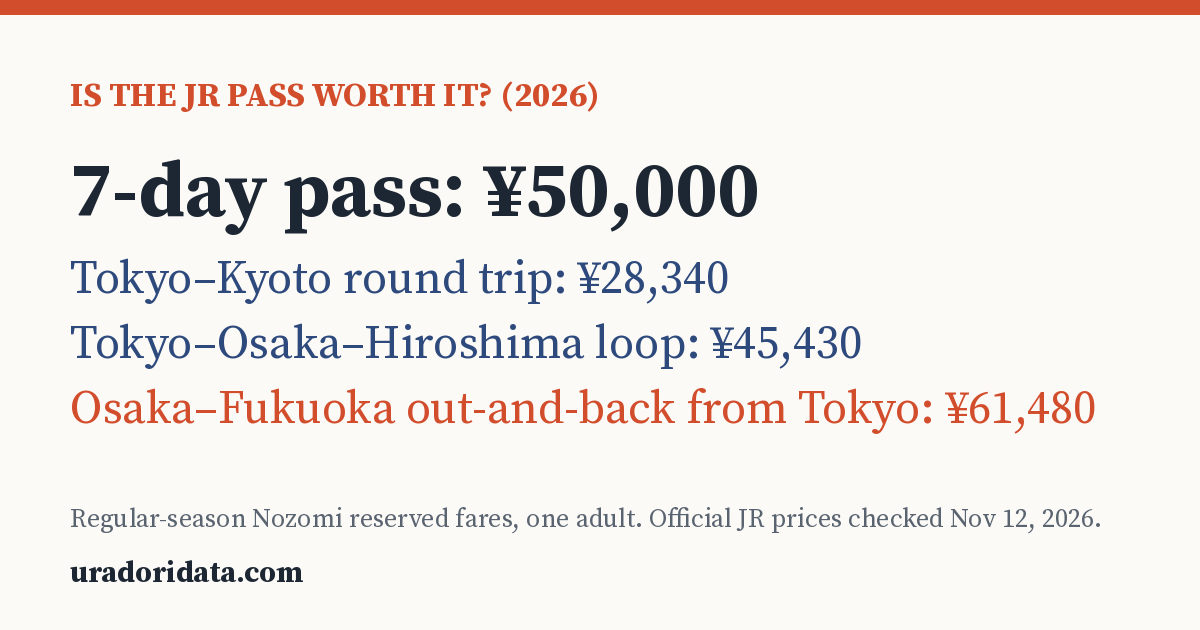
Quick answer: For most first trips, no. A 7-day Japan Rail Pass costs ¥50,000 (about $314) when you buy it on the official site. A Tokyo–Kyoto round trip on the bullet train costs ¥28,340 if you just buy tickets, and even a Tokyo–Osaka–Hiroshima loop comes to ¥45,430. The pass starts paying off when your week includes a trip as far as Fukuoka, or two long round trips, which is roughly ¥50,000 of Shinkansen travel in seven days.
What the JR Pass costs in 2026
These are the official prices on the JAPAN RAIL PASS website. Buying online is cheaper than buying an exchange order from an overseas agent.
| Pass (adult) | Ordinary, bought online | Ordinary, overseas agent | Green Car, bought online |
|---|---|---|---|
| 7 days | ¥50,000 (~$314) | ¥53,000 | ¥70,000 |
| 14 days | ¥80,000 (~$502) | ¥84,000 | ¥110,000 |
| 21 days | ¥100,000 (~$628) | ¥105,000 | ¥140,000 |
One catch matters more than anything else on this page: the pass doesn’t cover the Nozomi or Mizuho, the fastest trains on the Tokyo–Osaka–Fukuoka line. You can ride the Hikari and Kodama at no extra cost, or buy a special “NOZOMI MIZUHO Ticket” for each Nozomi ride. That ticket costs ¥4,960 for Tokyo to Kyoto or Shin-Osaka and ¥6,500 for Tokyo to Hiroshima.
Break-even table: pass vs. buying tickets
We priced five common itineraries with regular tickets, using the station price for a reserved seat on the Nozomi in the regular season. That’s the ticket most travelers without a pass buy. We only counted the Shinkansen legs.
| Itinerary (Shinkansen legs) | Regular tickets | vs. 7-day pass (¥50,000) |
|---|---|---|
| Tokyo–Kyoto round trip | ¥28,340 (~$178) | Tickets ¥21,660 cheaper |
| Tokyo → Kyoto, then Shin-Osaka → Tokyo | ¥28,890 (~$181) | Tickets ¥21,110 cheaper |
| Tokyo–Hiroshima round trip | ¥39,520 (~$248) | Tickets ¥10,480 cheaper |
| Tokyo → Shin-Osaka → Hiroshima → Tokyo | ¥45,430 (~$285) | Tickets ¥4,570 cheaper |
| Tokyo → Shin-Osaka → Hakata (Fukuoka) → Shin-Osaka → Tokyo | ¥61,480 (~$386) | Pass ¥11,480 cheaper |
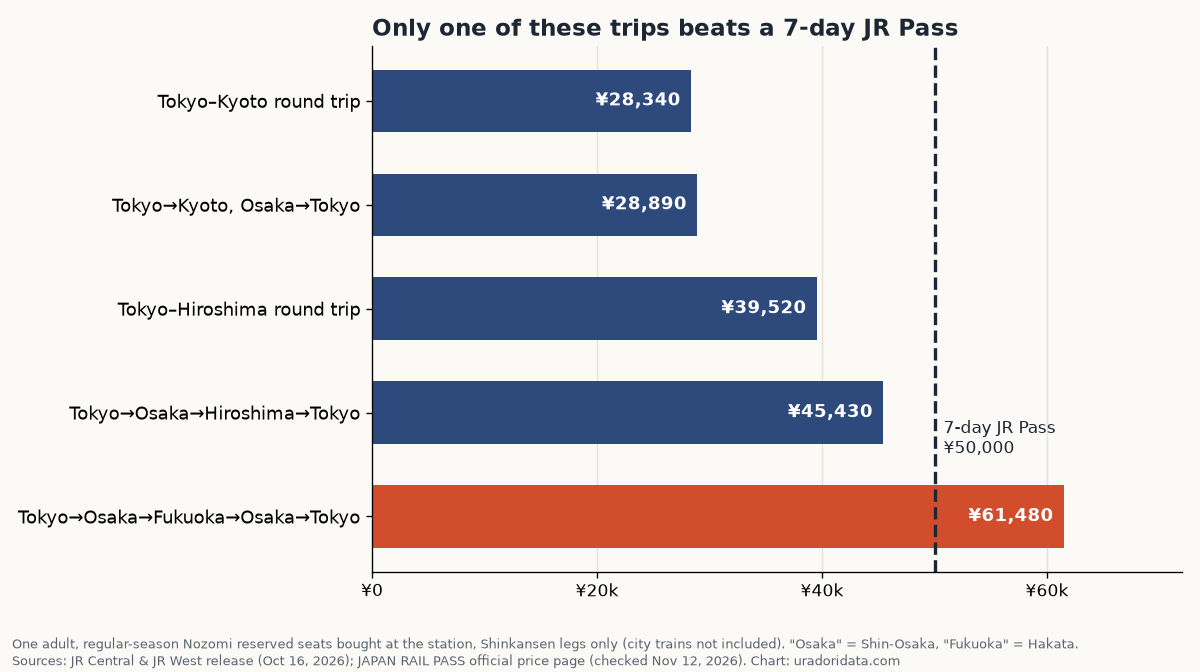
The pattern is simple. A trip that stays between Tokyo, Kyoto and Osaka doesn’t get close to ¥50,000. Adding Hiroshima gets you near it, so the answer then depends on the smaller JR rides you add on top, such as JR lines in Tokyo, Kyoto or Osaka. In our Tokyo–Osaka–Hiroshima loop, those extra rides would have to add up to more than ¥4,570 in the same week. The pass only wins clearly once Fukuoka is in the plan.
The Nozomi question
With a pass, you save money by riding the Hikari, which is a little slower than the Nozomi. If you want the Nozomi anyway, the special tickets add up quickly. Here’s what our two longest itineraries would cost on top of the pass if every leg were a Nozomi:
| Itinerary | NOZOMI MIZUHO Tickets | Pass + tickets | Regular tickets |
|---|---|---|---|
| Tokyo → Shin-Osaka → Hiroshima → Tokyo | ¥4,960 + ¥4,170 + ¥6,500 = ¥15,630 | ¥65,630 | ¥45,430 |
| Tokyo → Shin-Osaka → Hakata → Shin-Osaka → Tokyo | 4 × ¥4,960 = ¥19,840 | ¥69,840 | ¥61,480 |
If the Nozomi matters to you, the pass loses even on the Fukuoka loop. It only makes sense if you’re happy on the Hikari.
Your three real options
- Buy tickets as you go (no upfront cost). This is the best choice for Tokyo–Kyoto–Osaka trips and most Hiroshima trips. You can take any train, including the Nozomi, with no extra ticket.
- 7-day JR Pass (¥50,000). It’s worth it if your Shinkansen legs in one week add up to more than ¥50,000 and you’ll ride the Hikari, for example Tokyo–Osaka–Fukuoka and back.
- 14-day JR Pass (¥80,000). This only makes sense for two weeks of long-distance travel. Two Fukuoka-style loops would do it; a relaxed two-week trip usually won’t.
For local rides, an IC card is usually easier than any pass. See our guide to which Suica or PASMO card visitors can get now. If you’re working out how much yen to carry for the rest of your trip, our cash guide covers ATMs and card acceptance.
Regular tickets get pricier from July 2027
On October 16, 2026, JR Central and JR West announced a higher reserved-seat charge on the Nozomi and Mizuho for tickets bought on or after July 1, 2027. Non-reserved charges stay the same. Tokyo to Shin-Osaka goes from ¥14,720 to ¥15,420, and Tokyo to Hiroshima goes from ¥19,760 to ¥20,620.
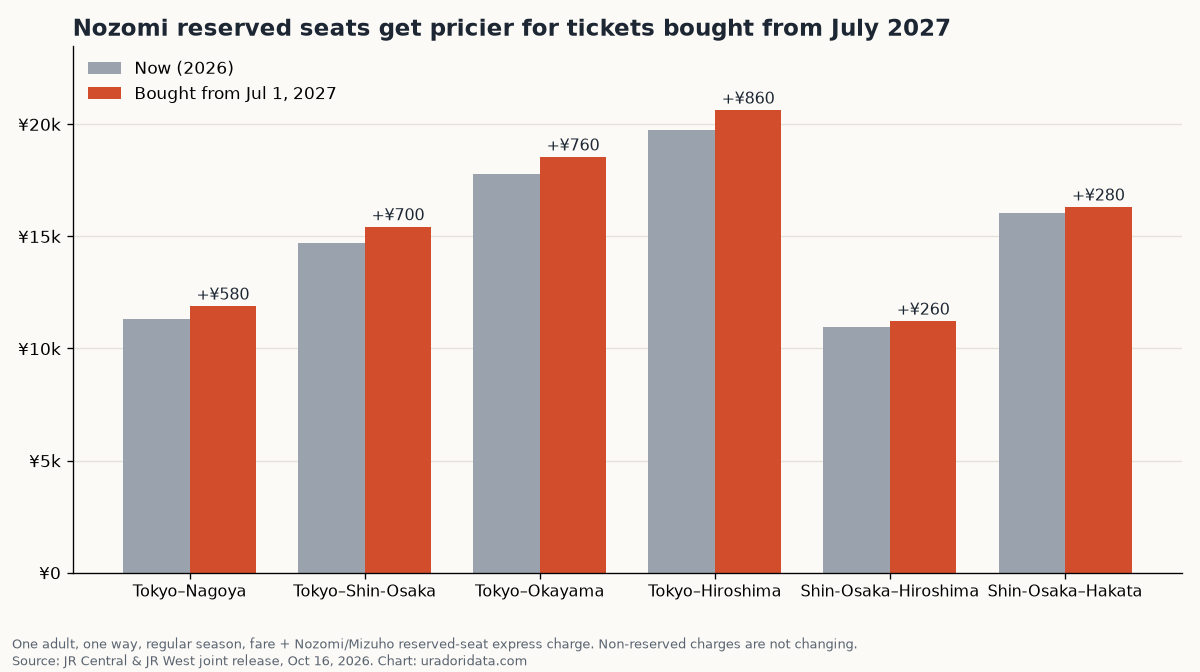
For a trip in 2026 or the first half of 2027, today’s prices apply. After the change, our Tokyo–Osaka–Hiroshima loop would come to ¥47,250 on regular tickets, still under the price of a 7-day pass. The release doesn’t say anything about JR Pass prices. If those change, the official price page will show it.
FAQ
Is the JR Pass worth it for Tokyo, Kyoto and Osaka only?
Not on Shinkansen fares alone. A round trip comes to about ¥28,000 to ¥29,000, a little over half the price of a 7-day pass.
Do these prices change by season?
Yes, reserved seats do. The reserved-seat charge is ¥200 lower in the off-peak season, ¥200 higher in the peak season and ¥400 higher in the busiest periods, per one-way trip on the Tokaido Shinkansen. That doesn’t change any of the answers in our table.
Can I ride the Nozomi with a JR Pass?
Yes, if you buy a NOZOMI MIZUHO Ticket before boarding, once per ride. It’s ¥4,960 from Tokyo to Kyoto or Shin-Osaka.
Is it cheaper to buy the pass online or from an agent?
Online. The 7-day pass costs ¥50,000 on the official site and ¥53,000 as an exchange order from an overseas agent.
Sources
- JAPAN RAIL PASS: Types and prices (checked November 12, 2026)
- JAPAN RAIL PASS: Use of NOZOMI/MIZUHO trains (checked November 12, 2026)
- JR West and JR Central: Nozomi/Mizuho reserved-seat and Green Car charge revision (Japanese, October 16, 2026)
- JR Central: fare table and seasonal adjustments for reserved seats (Japanese)
- Ekitan: Tokyo–Kyoto Shinkansen fare (Japanese, cross-check for ¥14,170)
- European Central Bank reference rates (USD/JPY 159.23 on November 11, 2026)